CBSE On-Screen Marking 2026: What Digital Answer Sheet Evaluation Means for Schools and Teachers
CBSE has introduced On-Screen Marking for Class 12 board exams starting 2026. Answer sheets will be scanned and displayed on computer screens for teachers to evaluate digitally instead of checking physical paper bundles.
This is the biggest change to board exam evaluation in years. And it raises a question every school in India should be asking: what comes next?
What is On-Screen Marking (OSM)?
On-Screen Marking means physical answer sheets are scanned into digital format. Teachers then view these scanned copies on a computer and award marks on screen instead of using a red pen on paper.
CBSE confirmed this in a notification to principals of all affiliated schools. The exact wording: the Board has decided to introduce On-Screen Marking for the evaluation of Class 12 answer books beginning with the 2026 examinations.
Class 10 answer sheets will continue to be checked in physical mode for now.
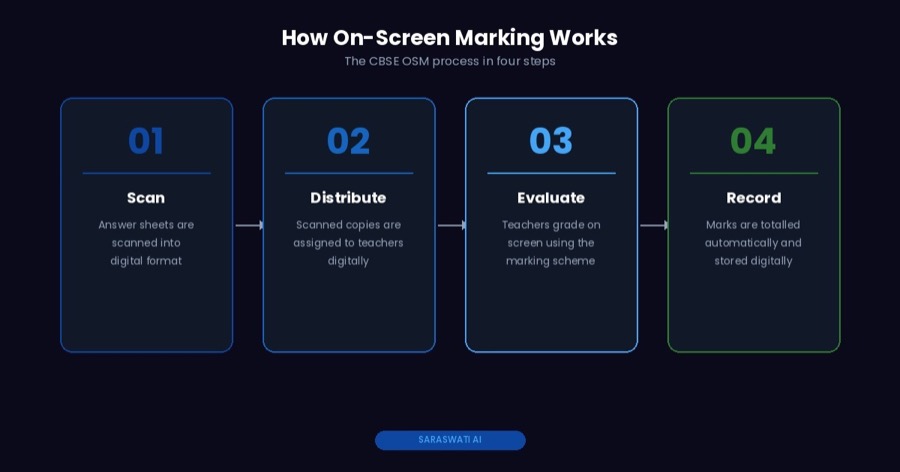 The OSM workflow in four steps
What OSM changes for teachers
The core job stays the same. Teachers still read answers, judge quality, and award marks. That part is not changing.
What changes is the workflow around it.
No more carrying bundles of answer sheets between schools and evaluation centres. No more physical sorting, bundling, and transporting thousands of papers. No more manual totalling of marks on the front page of each answer book.
The system handles scanning, distribution, totalling, and record-keeping. Teachers focus on the actual evaluation.
CBSE has also reduced the daily evaluation load from 30 answer scripts per teacher to 20. Combined with digital delivery of scripts, teachers spend less time on logistics and more time on each paper.
Where does AI fit into this?
This is where the conversation gets interesting.
CBSE has been clear that AI is not replacing teachers in the evaluation process. The board categorically denied claims that AI would check Class 10 or Class 12 answer sheets.
But CBSE is already using AI in other parts of the evaluation pipeline.
During the 2024-25 session, CBSE used AI tools to compare internal assessment marks with written exam marks across schools. The system flagged roughly 500 schools where the gap between internal and external marks was suspiciously large. Those schools received advisories to review their internal assessment practices.
That is AI being used for quality control and moderation. Not grading. Not replacing teachers. But watching for patterns that humans would miss across lakhs of answer sheets.
A dedicated AI-based Digital Experience Centre has been set up at CBSE's Dwarka complex in Delhi. Pilot runs for AI-assisted evaluation workflows have been conducted there.
The direction is clear. AI will play a growing role in how Indian boards handle evaluation. The question is not if, but how fast.
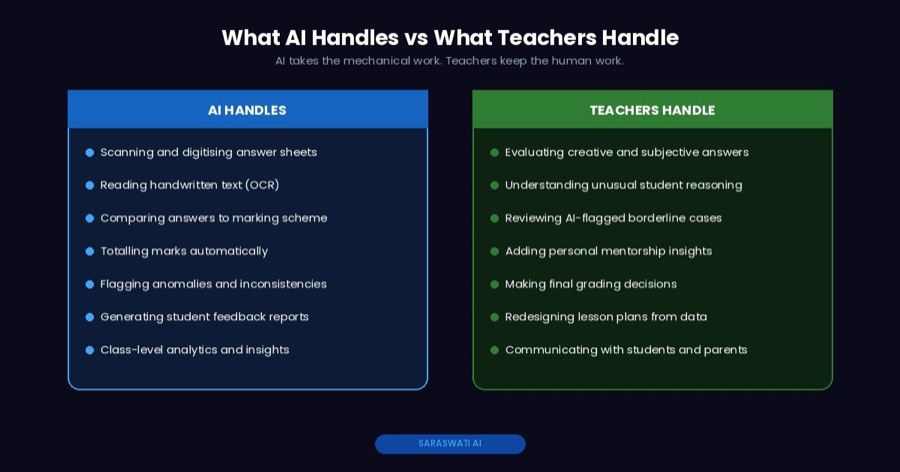 What AI does now vs what teachers do
What this means for schools right now
If you run a CBSE-affiliated school, here is what you should be preparing for.
Infrastructure. OSM requires scanning facilities. Schools designated as evaluation centres will need high-speed scanners, reliable internet, and computer workstations for evaluators. Start budgeting for this now.
Teacher training. Evaluating on a screen is different from evaluating on paper. Teachers need to get comfortable with digital tools before the evaluation season hits. CBSE has indicated that training for on-screen evaluation will begin before the full rollout.
Process changes. Answer sheet collection, storage, and transportation workflows will change. Schools need to plan for scanning logistics, not just physical paper handling.
Parent communication. Parents will have questions. Prepare clear communication about what OSM means and what it does not mean. The biggest misconception to address: AI is not checking your child's paper. Teachers still do that.
The bigger picture for Indian education
OSM is step one. It digitises the process. That is necessary before you can layer intelligence on top.
Once answer sheets are digital, the possibilities open up. Pattern recognition across thousands of papers. Automated flagging of inconsistent marking. Data on which topics students struggle with across an entire board, not just a single classroom.
And eventually, AI-assisted grading that supports teachers rather than replacing them. A system where AI reads a handwritten answer, suggests a score based on the marking scheme, and a teacher confirms or adjusts. That hybrid model is what education boards around the world are moving toward.
India has 9.5 million school teachers. They collectively check billions of answer sheets every year. Even a 30% reduction in time spent on repetitive grading would free up hundreds of millions of hours for actual teaching.
That is the real promise of digital evaluation. Not replacing teachers. Giving them their time back.
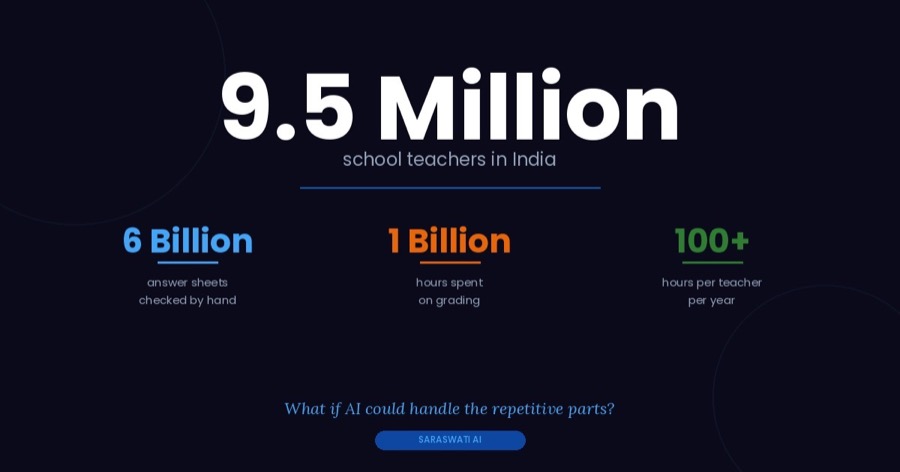 The scale of the opportunity
What should teachers do right now?
If you are a teacher reading this, two things.
First, get comfortable with digital tools. OSM is coming. The faster you adapt, the easier the transition will be.
Second, start thinking about what you would do with the time you currently spend on repetitive grading. That time is going to start coming back to you. Whether through OSM, AI-assisted tools, or a combination of both.
The answer sheet checking process in India is changing. CBSE just made the first move. The rest will follow.
We are tracking every development in AI-powered education in India. Follow Saraswati AI on LinkedIn for updates.